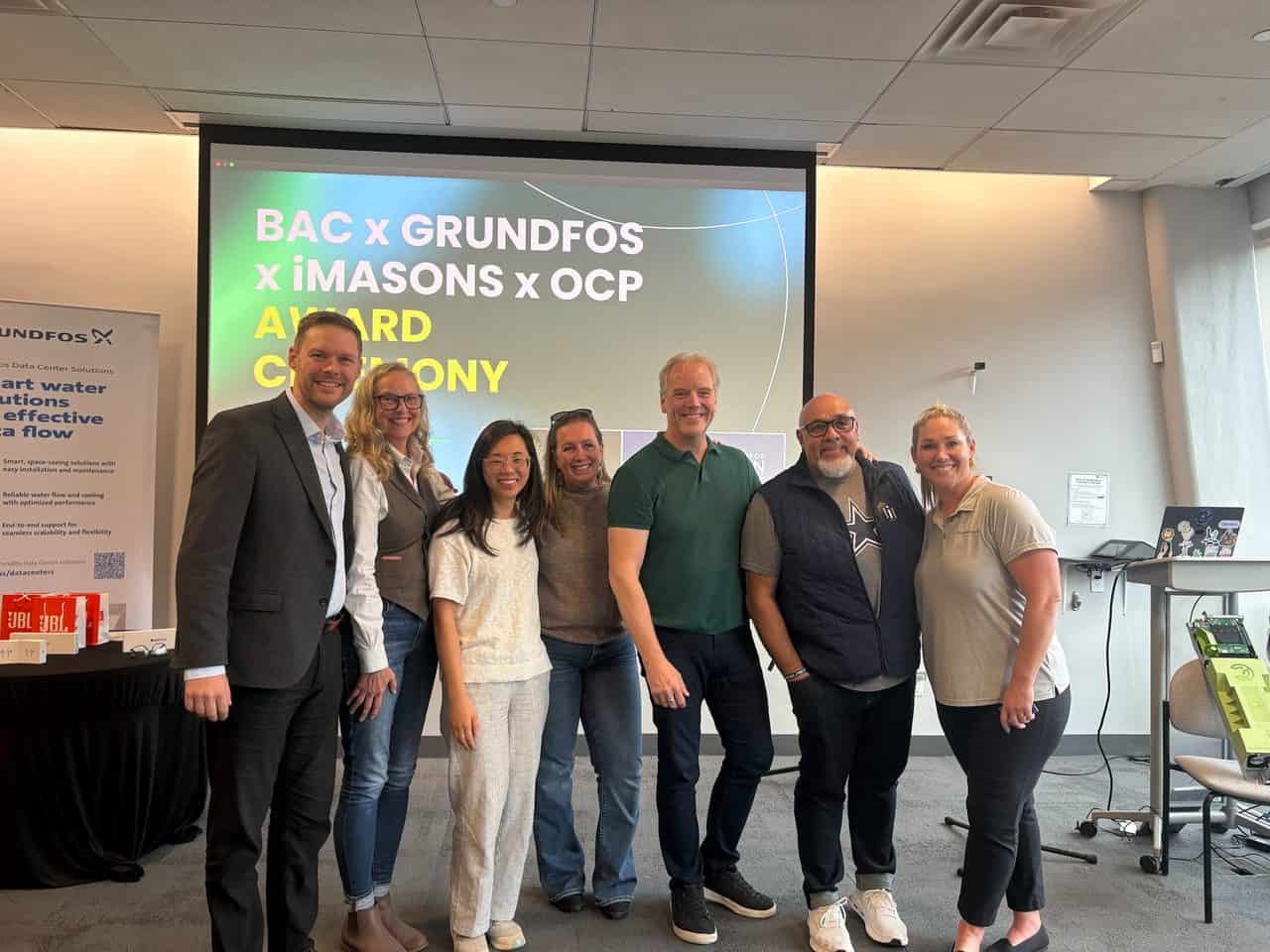
New York, New York – November 5, 2026 – Infrastructure Masons (iMasons), alongside global water technology company, Grundfos and the Open Compute Project (OCP), held a hackathon on October 2–4 at New York University to ask students to tackle a critical challenge facing the digital infrastructure industry: How do we build a sustainable future for AI and data centers?
Under the theme Sustainable Data Centers, teams tackled two real-world challenges: identifying where next-generation AI data centers should be built, and finding innovative ways to reuse the heat they generate.
What was most inspiring wasn’t just what the teams built. It was how quickly their thinking evolved.
Many participants started the weekend asking: “What is a data center?”By the end, they were asking: “How do we make AI and data centers more sustainable for our communities?”
Turning Data Into Better Decisions
The first challenge from OCP asked teams to go beyond simply identifying a potential data center site. Their mission was to develop a decision engine that could determine where a next-generation AI data center should be located by balancing environmental impact, infrastructure availability, resilience, community considerations, and long-term economic viability.
The challenge required teams to bring together multiple sources of data and turn that information into a tool capable of supporting a complex, real-world infrastructure decision.
The winning team, Skywalkers, did exactly that. They combined risk and co-benefit information, iMasons Social Accord data, and AI-powered sentiment analysis to create a dashboard and web-based analysis tool. Runners-up Wear and Watt collected data across 3,109 counties, allowing analysts to customize the weighting of different factors and identify the locations that best meet their specific data center requirements. And third place, Kiri created a chatbot to translate needs into insights.
In just one weekend, students were no longer simply learning about data centers. They were thinking like the people who will ultimately design, build, and make decisions about the infrastructure powering our AI future.
Turning Waste Heat Into Community Value
The heat-reuse challenge from Grundfos asked teams to rethink waste heat as a potential community resource. They were challenged to develop a technically feasible and economically viable system that could capture, upgrade, and redistribute data-center heat to the communities and buildings where it could create the greatest value.
The winning team, HeatOS developed a UI showing buildings hour by hour and building by building, using network physics to understand where data-center heat could be redistributed and create value. The runners up, Hot Takes took another innovative approach, exploring phase-change materials (PCMs) to transport and optimize heat. Thermal Commons placed third with creating a community including farms and rural homes.
These solutions demonstrated that sustainability isn’t a single technology or a single metric—it requires systems thinking. By connecting data centers with the energy, buildings, materials, and communities around them, these students demonstrated how AI infrastructure can turn what was once considered waste or a by-product into a valuable resource, creating shared benefits for both industry and communities.
The Next Generation Is Already Thinking Differently
Students aren’t simply learning about the infrastructure industry—they are being invited to help shape it. Hackathons provide this opportunity.
Let’s look at the numbers and understand how we are shaping future leaders:
- 124 students registered for the hackathon – all of these students provided their resumes, expressing interest in working in the digital infrastructure industry
- 58 students went ahead and completed the hackathon
- 17 teams were formed and solved industry-related problems
- Winning teams will head to the OCP Global Summit, as well as an invitation to the iMasons Accelerator Program
When you give the next generation real problems, real data, and real-world constraints, something powerful happens. They start seeing the connections between AI, energy, water, communities, climate, economics, and infrastructure.
The students at NYU aren’t just preparing for the future of digital infrastructure. They’re already helping us shape what that future could look like. If your organization wants to get involved in 2027, contact us angela@imasons.org
About Infrastructure Masons
Infrastructure Masons (iMasons) is a global, nonprofit, professional association of individuals connected and empowered to build a greater digital future for all by uniting people that innovate to drive efficiency. Since its launch in 2016, the organization has brought together 6,000 individuals representing US $1.5T+ in infrastructure projects across 130 countries. iMasons provides an agnostic platform for members to connect, grow, and give back.
To date, iMasons has contributed USD 1+ million in scholarships, launched Member Focus Groups and opened regional and local Chapters across four continents. In 2022, iMasons spearheaded the Climate Accord, uniting leaders on carbon reduction in digital infrastructure. In 2025, iMasons launched a power initiative that brings together industry stakeholders and the energy sector to address U.S. power capacity timing challenges and accelerate time to power. iMasons publishes an annual State of the Digital Infrastructure Industry report with input from its global community of technology, operations and business professionals.
To learn more, visit imasons.org.